
Easy road
24 Steps
19.44×Final step coefficient · original game


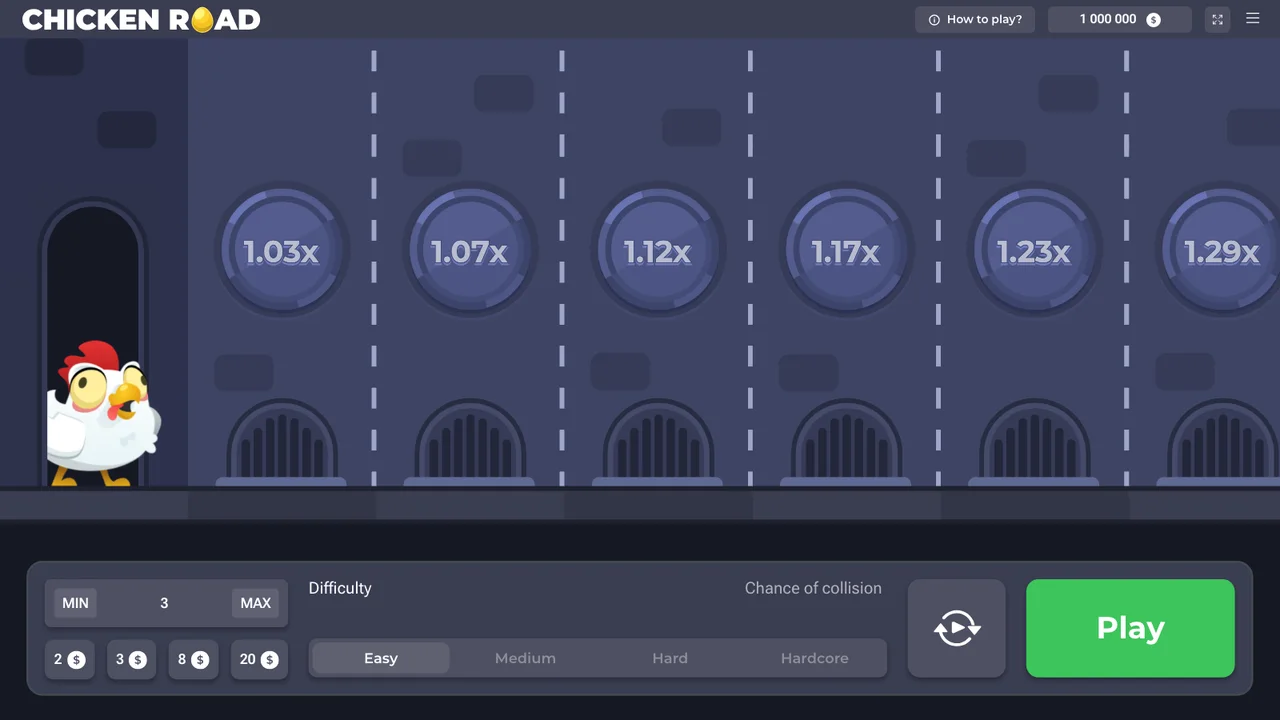
Practice credits have no cash withdrawal value. This game view is for adults 18+.
Published theoretical return: 98% · Game win ceiling: 10,000 USD
Read this title’s rule tablePick your road
A harder mode changes the steps and multipliers. It does not make the next outcome predictable.
24 Steps
19.44×Final step coefficient · original game
22 Steps
1,788.8×Final step coefficient · original game
20 Steps
41,321.43×Final step coefficient · original game
15 Steps
2,542,251.93×Final step coefficient · original gameDecorative coins; game values come from InOut.
Our test
Demo outcomes, not a forecast.
Original game · survival at the first step · pointwise Wilson intervals
The game family

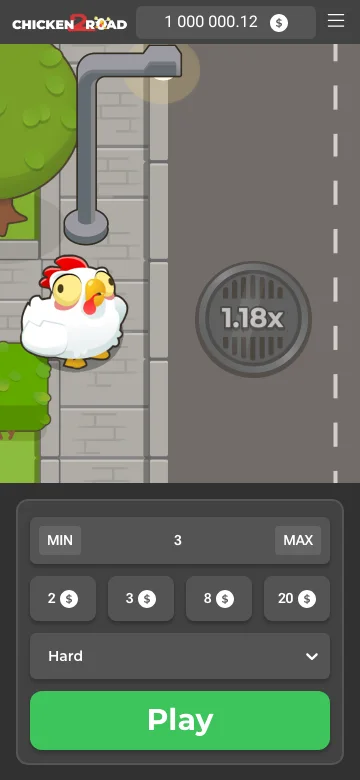
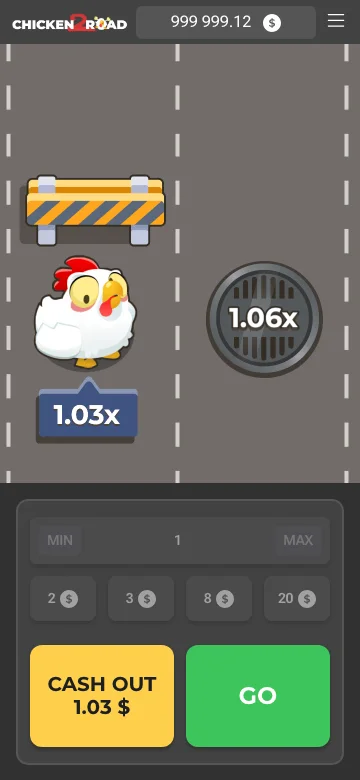
Our own demo captures
Read next
Learn the controls and cash-out choice.
2Compare the complete multiplier ladders.
3Read the published provider figures.
4Understand what the evidence can establish.
5Use a browser and recognise unofficial apps.
6Separate the game from misleading claims.
7Check your chosen operator’s terms.
8Recognise claims about future outcomes.
Chicken Road is an InOut Games gambling title in which a chicken advances across a road of separate steps. You choose a difficulty and a stake, then decide whether to collect after successful steps or attempt another position. An unsuccessful step can lose the stake.
The choice on screen is simple, but the numbers need care. The available collect amount belongs to a position already reached. A larger coefficient ahead belongs to a position you still have to reach. Seeing that next figure does not add it to your balance.
Chicken Road Info brings the two games, their free demos and our test method together. Compare the two titles, look up unfamiliar terms and use the demo to locate the controls. Knowing what a number describes is more useful than mistaking a large multiplier for a likely result.
The original and Chicken Road 2 have separate rule tables. Keep the title and difficulty attached to any value you read. Their shared visual theme does not make their step counts, opening coefficients or permitted stakes interchangeable.
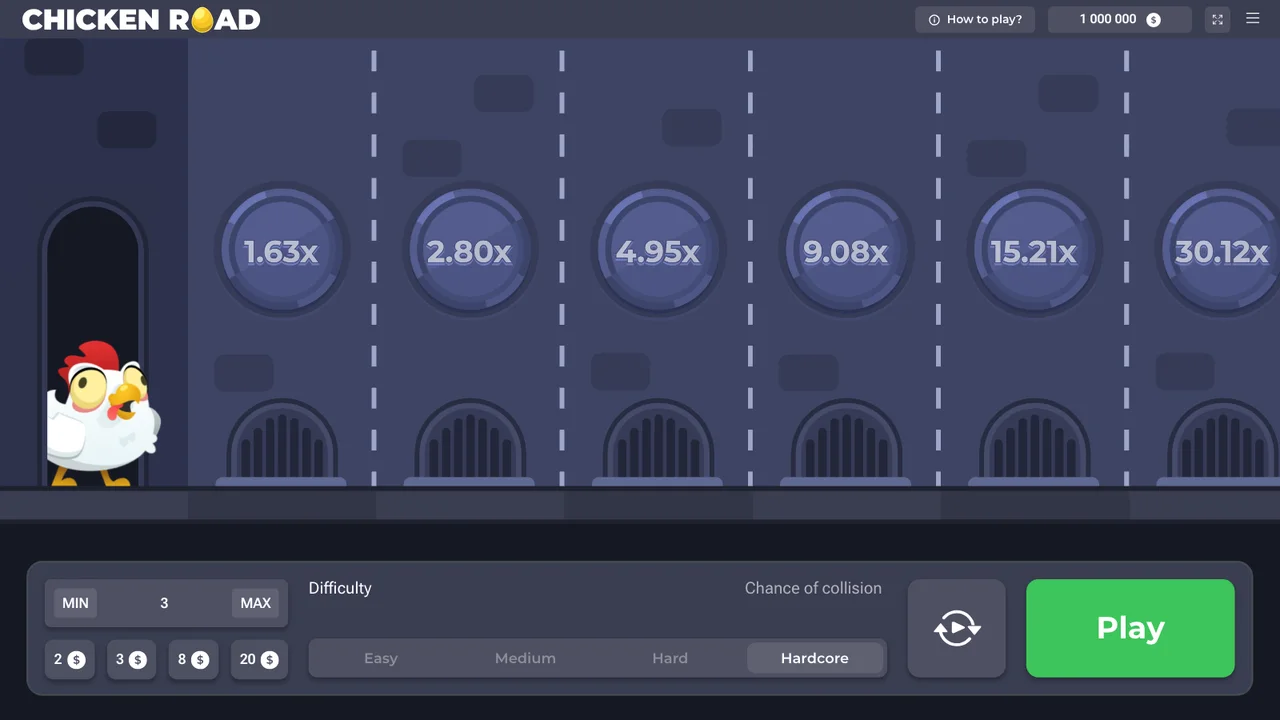
The original offers Easy, Medium, Hard and Daredevil modes. Easy has 24 steps, Medium has 22, Hard has 20 and Daredevil has 15. Each road has its own ladder of multipliers.
Easy begins at ×1.03 and ends at ×19.44. Medium begins at ×1.12 and ends at ×1,788.80. Hard reaches ×41,321.43, while Daredevil reaches ×2,542,251.93. Read those endpoints together with the game's 10,000 USD win cap.
The permitted stake range is 0.01–150 USD. That tells you the game limits, not the minimum deposit at an outside casino. An account using another currency needs its own cashier labels and conversion information.
InOut publishes 98% RTP for this title. Its complementary house edge is 2% under the same model. Neither figure promises a session result or tells you whether the next step will succeed.
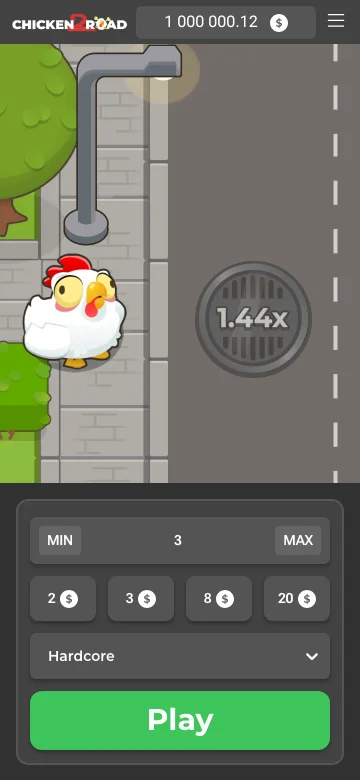
Chicken Road 2 keeps the move-or-collect decision and extends each road. Easy has 30 steps, Medium 25, Hard 22 and Daredevil 18. The first coefficients are ×1.01, ×1.08, ×1.18 and ×1.44 respectively.
The sequel's stake range is 0.12–200 USD, with a 20,000 USD game cap. More positions and a larger cap are facts to compare. They are not enough to claim that a session is more likely to be profitable.
InOut publishes Chicken Road 2 RTP as 95.5%, with a 4.5% house edge. That is below the original’s 98% theoretical return. A short demo run, a calculator or a review score cannot independently establish either game’s long-run percentage.
Use the side-by-side comparison for road lengths and individual coefficients. If a screen simply says Chicken Road without distinguishing the sequel, check its provider and rule panel before choosing which table applies.
The demo uses practice credits with no cash withdrawal value. It is useful for seeing the mode menu, stake field, move control and collect control together. You can learn the interface without turning a large practice balance into a money claim.
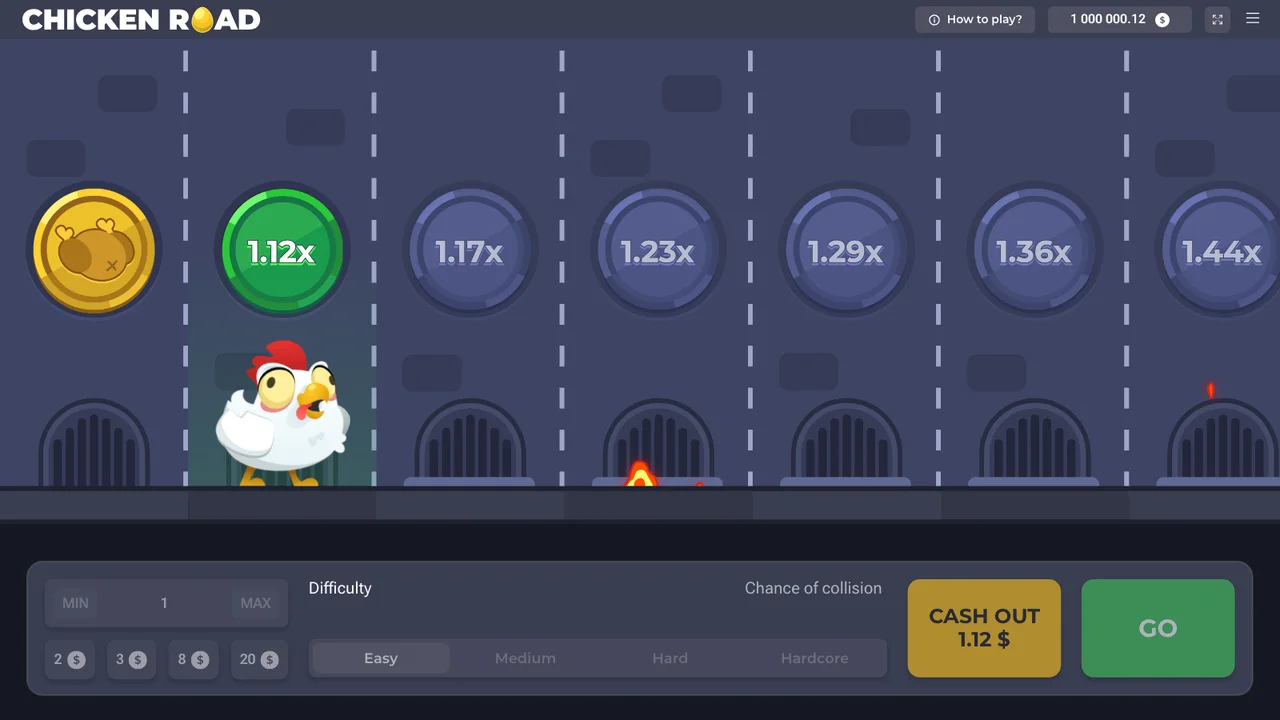
Select one title, choose a road and read the first coefficient. After a successful step, compare the current amount with the figure ahead. Collect finishes the active round; continue tries another position under the game's rules.
If the screen is small, expand the view so labels are readable. Wait for a round or loading state to finish before pressing again. A delayed animation is not a reason to make several rapid touches while the current state is unclear.
A browser view is enough to explore the game. InOut does not provide a standalone Chicken Road application. Similar store products can be third-party apps or clones; a home-screen shortcut remains a link to a web page.
Easy is useful for beginning to read the controls because its early coefficients are smaller. It still permits a real-money stake to be lost. The label does not mean a round is safe or that practice changes a later random outcome.
Medium, Hard and Daredevil use different numbers and road lengths. Read the opening positions as well as the endpoint. A shorter road with a much larger final coefficient is not a shortcut to an amount you can count on receiving.
Changing the stake scales the money attached to the coefficients. Changing difficulty selects another ladder. Neither gives an outside tool access to the random values behind the next result.
After a successful step, the decision is whether to take the amount available or keep the round exposed. A fixed collect rule can make that decision less hurried. It cannot ensure the round reaches the position named in the rule.
Gross return means the amount before subtracting the stake. Multiply the stake by the reached coefficient to calculate it before the game cap. Net result subtracts the stake; it is a different quantity.
The large coefficients at road endpoints do not override those ceilings. A calculator that multiplies amounts must be read alongside the relevant game cap.
When comparing a series of rounds, include lost stakes too. A screenshot of the largest collect shows one outcome and leaves out the other attempts. Counting only positive results makes a session look different from its full money total.
Collecting inside the game is not withdrawing from a casino. A withdrawal request belongs to the cashier and may involve account checks. Game coefficients do not specify payment methods, approval conditions or payout timing.
The statistics blocks show the demo rounds included in each table. Read their title, difficulty, number of rounds and dates before comparing them. Those labels explain which results a percentage actually counts.
A chart of reached positions describes those rounds, not your next attempt. An absent position in a limited run does not prove it cannot occur. Unknown, unavailable and zero are different labels and should remain different in any calculation.
The largest reached coefficient also differs from a typical result. Use the median, mean and total rounds beside it rather than letting a dramatic best result represent the entire run. The CSV files let you read the underlying rows.
A demo run cannot independently determine theoretical RTP. The provider publishes 98% for the original and 95.5% for the sequel. A chart with many positions or a very large return still describes only its included rounds.
InOut Games makes the title; a casino operator handles registration, balances, verification and payments. Before a deposit, check the legal operator, licence information, location rules and account terms. A working game page does not answer whether you may use a service where you live.
Read available payment methods in the cashier itself. They can vary by operator and account. We do not invent a universal payment option, a named casino offer or a payout deadline because the game appears on a page.
Read promotions separately. Wagering, game contribution, maximum promotional stake and withdrawal restrictions belong to a particular offer. Free demo credits are not a no-deposit promotion, and free spins may refer to a different reel game.
If an account issue occurs, keep the relevant payment or round reference and use the operator's known support route. Chicken Road Info explains the terms but cannot release a balance or approve identity documents.
On a phone, make the current stake and collect offer readable before asking for a move. Expand the game panel if the road is cramped. Wait for each animation to finish so you can distinguish an active round from a settled balance.
A provably fair claim is another question. To reproduce a result you need the published algorithm and the relevant inputs, including commitments, seeds and a nonce. We have not independently verified such a reproducible process for these titles.
Avoid unknown APKs offered as a route to secret results. Do not share a password or one-time code with someone claiming to unlock practice money. A familiar game image in a message is not an identity check for the sender.
Use the glossary for a quick definition, the game reviews for title-specific tables and the account page for the difference between collect and withdrawal. Each answers a narrower question clearly, without turning an explanation into a promise about future play.
| Title | USD stake range | USD game cap | RTP |
|---|---|---|---|
| Chicken Road | 0.01–150 | 10,000 | 98% |
| Chicken Road 2 | 0.12–200 | 20,000 | 95.5% |
18+ only.
For adults 18+. Set a time limit and spending budget. Take breaks regularly. Never chase losses.
Chicken Road is an InOut Games title built around moving through steps and choosing when to collect. Other games use chicken imagery too, so check the full title and provider name. A viral clip alone may not identify which product or balance type it shows.
It is the InOut Games sequel with longer roads, a 0.12–200 USD stake range and a 20,000 USD game cap. InOut publishes its RTP as 95.5%. That is lower than the original game’s 98% theoretical long-run return.
You can use the browser version instead of installing a separate InOut game app. Similar store listings can be third-party products or clones. Use a mobile browser to read the title and controls, and treat a home-screen shortcut as a link rather than proof of a provider application.
Choose the title, stake and difficulty, then distinguish the available collect amount from the next coefficient. Collect finishes the active round; continue attempts another step and can lose the stake. Use practice credits to learn the controls before making a separate money decision.
No. Demo credits have no cash withdrawal value. A cashier withdrawal concerns a real casino account under its own terms. Do not pay a fee to someone claiming they can convert a practice balance or unlock it through a private message.
Gambling involves a risk of losing money. Set time and spending limits, never chase losses, and use support if play stops being enjoyable.